Greenwood County Probate Court Records
Greenwood County Probate Court is a separate elected probate office, not a division of the Clerk of Court. The court handles estate administration, trusts and estate disputes, marriage licenses and certified marriage-license copies, guardianships, conservatorships, involuntary commitments for alcohol or drug abuse and mental illness, minor settlements, and wrongful death settlement approvals. The county describes Estate, Commitment, and Marriage Divisions, which is useful because each division has a different access path and a different public-record boundary.
Probate Judge Travis W. Moore is identified in county probate search sources. The county probate page states that the court has contact with about 1,500 families each year, issues about 600 marriage licenses each year, and handles more than 250 mental-health cases annually. Those figures explain why Greenwood County probate records are not just old wills. They include active estate files, protected commitment matters, marriage-license work, and family-sensitive supervision records.
The county's Probate Court page is also the local gateway for marriage-license instructions and probate services. Estate search can be done online, while certified copies, older files, questions about sealed material, and questions about guardianship or commitment records should go to the Probate Court office.
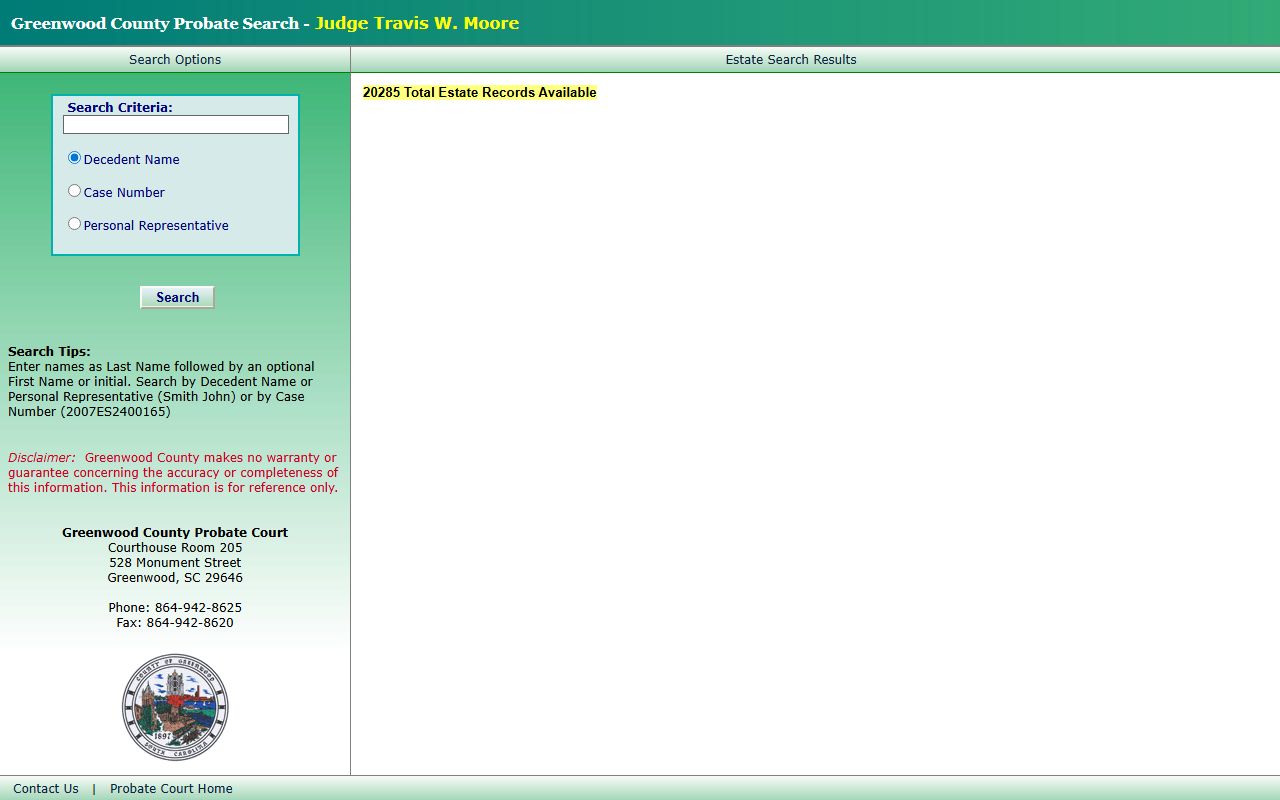
The county's own Greenwood Probate Search shows the local estate-search interface used for decedent, case number, and personal representative searches.
Probate Terms in Greenwood County
Probate words can be plain once tied to the file. In Greenwood County Probate Court, the same estate may show a decedent, a will, a personal representative, creditor deadlines, inventories, accountings, orders, and closing papers. Guardianship and conservatorship records use different terms because they involve care or finances for a living person, often a minor or incapacitated adult.
- Testator
- The person who made a will before death.
- Executor
- The person named in a will to carry out estate duties. South Carolina records may also use personal representative.
- Intestate
- A death without a valid will, so estate distribution follows state law.
- Guardianship
- A court-supervised role for personal care decisions for a minor or incapacitated person.
- Conservatorship
- A court-supervised role for managing money, property, or financial affairs.
Search Greenwood County Probate Files
Greenwood County has two official online probate search channels. The local county search is tailored to Greenwood estate files. The statewide South Carolina Probate File Search covers probate-file searching by case number or name and returns case-level columns. If the online result does not answer the question, the next step is the Probate Court office because online indexes do not replace certified copies or full file review.
- Start with the Greenwood Probate Search when the record is likely an estate opened in Greenwood County.
- Choose the search path that fits the information known: decedent name, case number, or personal representative.
- Use the case-number format shown by the county when known, such as an estate number with the county code embedded.
- Check the statewide probate search if the local search is incomplete or if the county of filing is uncertain.
- Contact Probate Court Room 205 for certified copies, older files, restricted matters, or questions about a file that does not appear online.
| Search Field | Required | How Greenwood Uses It |
|---|---|---|
| Decedent Name | Yes if selected | Enter last name, then optional first name or initial. |
| Case Number | Yes if selected | Use the court format, such as 2007ES2400165. |
| Personal Representative | Yes if selected | Search by the person appointed or tied to the estate. |
| Search Text | Yes | The text field changes meaning based on the chosen criteria. |
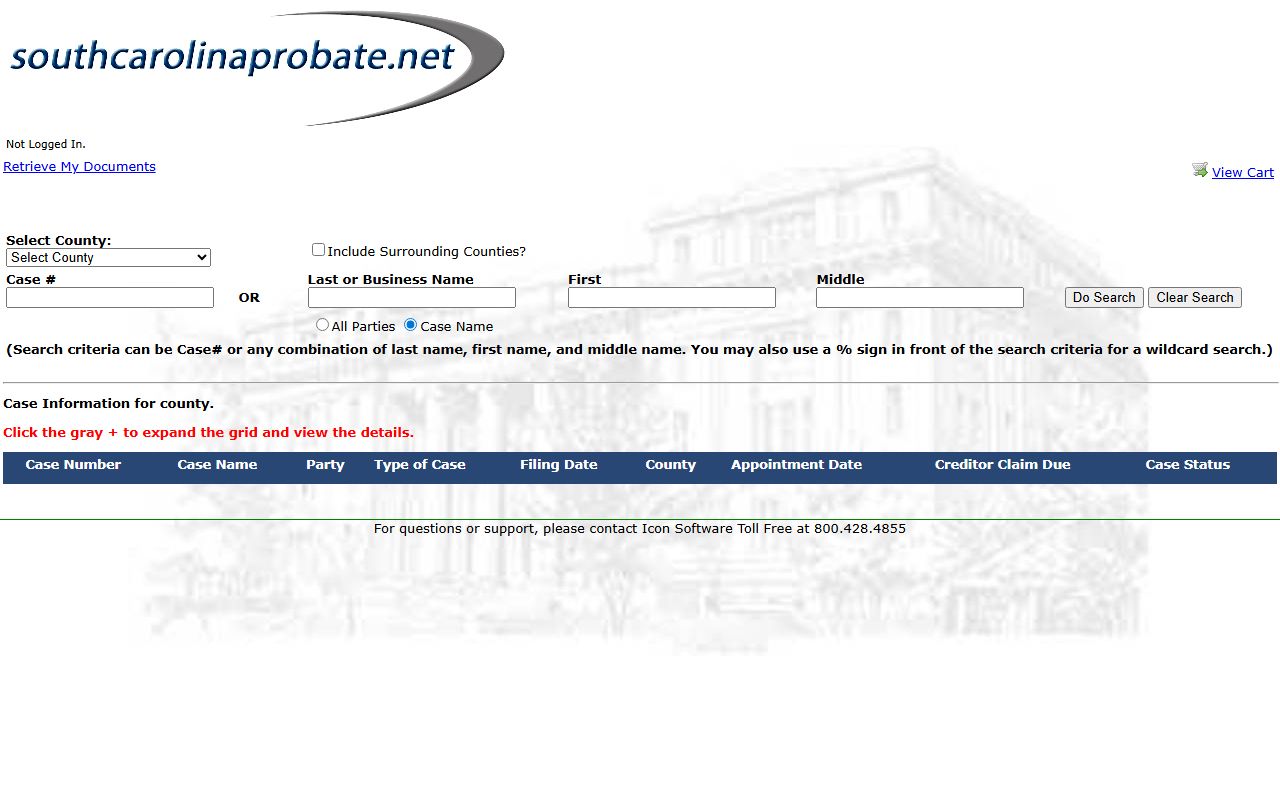
Statewide probate search results may show case number, case name, party, type of case, filing date, county, appointment date, creditor claim due date, and case status. A gray plus control can expand a grid result when details are available.
The state probate portal at southcarolinaprobate.net provides a second official path for Greenwood County probate records when the searcher has a party name or case number.
Greenwood Probate Court Contact
The Probate Court office is the file owner for Greenwood County probate records. Use the office for certified copies, estate administration questions, marriage-license certified copies, and files that are not fully available online. The county did not publish a complete probate fee schedule in the extracted official material, so fee questions should be confirmed before mailing a request or visiting in person.
Greenwood County Probate Court
Judge: Travis W. Moore
528 Monument Street, Room 205
Greenwood, SC 29646
864-942-8625
Fax: 864-942-8620
For non-case administrative records that are not part of a Probate Court file, Greenwood County also links an official NextRequest FOIA portal. FOIA is not the normal path for certified copies from an estate case, but it can matter for county records that are not held as court-file material.
Greenwood Probate Fees
Greenwood's official research set did not expose a full local probate fee schedule. That matters because estate costs can depend on the filing type, estate value, certified-copy need, and whether a guardianship, conservatorship, commitment, or settlement approval is involved. The safest local process is to identify the exact file type first, then ask Probate Court for the current amount and payment method.
| Probate Item | Amount or Status |
|---|---|
| Estate opening or administration filing | Confirm with Probate Court |
| Certified copy of probate record | Confirm with Probate Court |
| Guardianship or conservatorship filing | Confirm with Probate Court |
| Commitment proceeding cost | Restricted matter, confirm with Probate Court |
| Marriage-license certified copy | Confirm with Probate Court |
South Carolina Probate Code Article 3 governs estate administration, including opening an estate, appointment of a personal representative, creditor notice, inventory or accounting where required, payment of claims, distribution, and closing. The state statute helps explain the process, but the local court confirms the filing charge and copy cost.
The South Carolina Probate Code article on estate administration is available through the South Carolina Legislature.
What Probate Records Show
Estate records may show the decedent name, case number, case type, filing date, personal representative, appointment date, creditor claim deadline, case status, orders, inventories, accountings, claims, distributions, and closing documents. A will, if admitted, becomes part of the estate record unless access is limited by court order or law. The online index may show less than the paper or scanned file held by the Probate Court.
Guardianship and conservatorship records can include petitions, notices, medical or capacity-related details, accountings, bonds, court orders, and status reports. Those files often contain sensitive personal and financial information. Commitment records are even more sensitive because Greenwood Probate Court handles involuntary commitments for alcohol or drug abuse and mental illness. These are not routine public-search records.
Note: Online probate search results are index records, not a promise that every document in the file is public.
Restricted Probate Records
South Carolina public access starts with the right to inspect, copy, or receive public records under S.C. Code Section 30-4-30, but that right is limited by exemptions in S.C. Code Section 30-4-40 and by court-specific confidentiality rules. In probate work, the most common restricted subjects are commitments, minor settlements, guardianship details, sealed estate disputes, and records with private financial or identifying information.
Personal identifying information has a separate redaction rule under S.C. Code Section 30-2-330. That law supports written redaction requests for protected numbers and codes in public filings. If a probate file includes a Social Security number, driver's license number, passport number, bank or card number, PIN, or password, the request should identify the page that contains the protected item.
Criminal expungement law is not a probate-search tool, but the manifest includes S.C. Code Section 17-22-940 because it governs solicitor and SLED processing fees for qualifying expungements. Keep probate files separate from criminal record clearing: estate and guardianship access runs through Probate Court, while criminal expungement starts with the Eighth Judicial Circuit Solicitor.
The expungement fee statute at S.C. Code Section 17-22-940 is included here only as a contrast to Probate Court access.